Think about the last great leap in driving. For decades, it was incremental: a little more horsepower, a slightly smoother ride, a new cupholder design. But right now, we’re not in an era of incremental change. We’re living through a revolution. The experience of driving—the very act of piloting a machine from one place to another—is being fundamentally and utterly transformed by modern technology.
This isn’t just about adding a bigger touchscreen. It’s about the car evolving from a mechanical tool into a thinking, connected, and highly adaptive partner. The relationship between driver, machine, and the world is being rewritten in real-time. Let’s explore how the silicon chip is reshaping the asphalt jungle.
From Tool to Partner: The Philosophical Shift
For over a century, the car was a simple equation: Driver Input + Mechanical Systems = Motion. The driver was the sole brain, making every decision. Modern tech is flipping this script. The car now has its own nervous system—sensors, cameras, radars, and a central brain that processes information far beyond human capability.
The transformation isn’t just about doing things for us; it’s about augmenting our senses, compensating for our flaws, and expanding the very definition of what a car can be. We’re moving from pure operation to a state of collaboration. Buckle up; the ride is getting smart.
The Digital Cockpit: Your Car is Now a Computer on Wheels
Step inside a modern vehicle, and the first thing you notice is the silence of buttons. They’ve been replaced by sleek glass.
The Center Stack Revolution: Goodbye Buttons, Hello Interfaces
Gone is the sea of identical plastic switches. In its place: digital instrument clusters and massive central touchscreens, often spanning the entire dashboard.
- Customization is King: Your gauge cluster can show navigation, media, or vehicle data based on your preference. It’s a personal cockpit.
- Over-the-Air (OTA) Updates: This is the game-changer. Like your smartphone, your car can improve overnight. A sluggish infotainment system gets faster. New features like video streaming or a “karaoke mode” appear. Safety algorithms are refined. Your car gets better with age. A 2020 Tesla today is fundamentally more capable than the day it left the factory, thanks to OTA.
- Voice Assistants on Steroids: “Hey Mercedes,” “OK, BMW.” Native voice assistants understand natural language. You’re not just saying preset commands; you’re having a conversation. “I’m cold” triggers the climate control. “Find me a coffee shop along my route with a charging station” is a complex, layered request it can handle.
Connectivity: The Car Joins the Internet of Things
Your car is no longer an island. It’s a node in a vast network.
- Real-Time Everything: Traffic, weather, parking availability, and fuel/charging prices stream in live. Your navigation doesn’t just have a map; it has a living, breathing picture of the world at that second, routing you around a crash that happened three minutes ago.
- Remote Control & Digital Keys: Forget the key fob. Your phone is your key. You can pre-heat or pre-cool the cabin on a summer day from your office desk. You can lock/unlock, check vehicle status, or even summon it out of a tight parking spot from an app.
- The Ecosystem Play: Your car syncs with your calendar to suggest departure times. It can pre-set your home thermostat as you drive into the neighborhood. It’s becoming a seamless part of your digital life.
The Guardian Angel: Advanced Driver-Assistance Systems (ADAS)
This is where tech moves from convenience to potentially life-saving intervention. ADAS isn’t about taking over; it’s about creating a safety force field around the vehicle.
Sensory Overload (In a Good Way)
A modern car sees the world in superhuman detail. A combination of:
- Ultrasonic Sensors: For low-speed parking.
- Cameras: For reading signs, lane markings, and detecting objects.
- Radar: For calculating speed and distance of objects, especially in poor weather.
- Lidar: (Increasingly common) Creating a high-resolution 3D map of the environment with laser pulses.
These systems work in a sensor fusion symphony, building a 360-degree, real-time model of the world that no human driver could ever perceive.
The Suite of Standard Angels
Common ADAS features are becoming standard, transforming everyday stress into managed routine:
- Adaptive Cruise Control (ACC): Not just a set speed, but maintaining a safe distance from the car ahead, even in stop-and-go traffic. It turns a grueling highway commute into a relaxed journey.
- Automatic Emergency Braking (AEB): The car sees a pedestrian you might have missed or a sudden slowdown ahead and can apply the brakes faster than human reaction time. This single tech is saving thousands of lives.
- Lane Keeping Assist (LKA): Gently steers you back into your lane if you start to drift, often due to fatigue or distraction. It’s a nudge, not a takeover.
- Blind-Spot Monitoring & Cross-Traffic Alert: Your mirrors get digital eyes, warning you of hidden cars with visual or haptic alerts.
The collective effect? A dramatic reduction in driver cognitive load and a massive net cast for human error.
The Powertrain Paradigm: Electrification and Intelligence
The heart of the car—its powertrain—is undergoing the most radical tech-driven change in a century.
The Electric Motor: Software-Defined Performance
An electric vehicle (EV) is inherently a tech platform. The instant torque is just the start.
- One-Pedal Driving: Regenerative braking allows you to drive mostly with just the accelerator pedal. Lift off, and the car slows aggressively, converting motion back into battery charge. It’s an intuitive, efficient new way to drive.
- Performance Profiles at a Tap: Switch from “Chill” mode for efficiency to “Sport” or even “Track” mode that recalibrates steering, throttle, suspension, and stability control. The character of the car changes instantly via software.
- Intelligent Range Management: The navigation system doesn’t just route you; it calculates real-time range based on traffic, topography, and weather, and automatically plots required charging stops, even preconditioning the battery for optimal charging speed upon arrival.
Even Gas Engines Get Smarter
Hybrids and modern internal combustion engines are tech marvels too.
- Mild-Hybrid Systems: Small electric motors assist with acceleration, smooth stop/start systems, and power ancillary systems, saving fuel almost transparently.
- Cylinder Deactivation: Engines that can “turn off” half their cylinders under light load for highway cruising, seamlessly becoming a smaller, more efficient engine.
The Horizon: Autonomous Driving and Biometric Integration
We’re already seeing the next wave lapping at the shores.
The Steady March Toward Autonomy
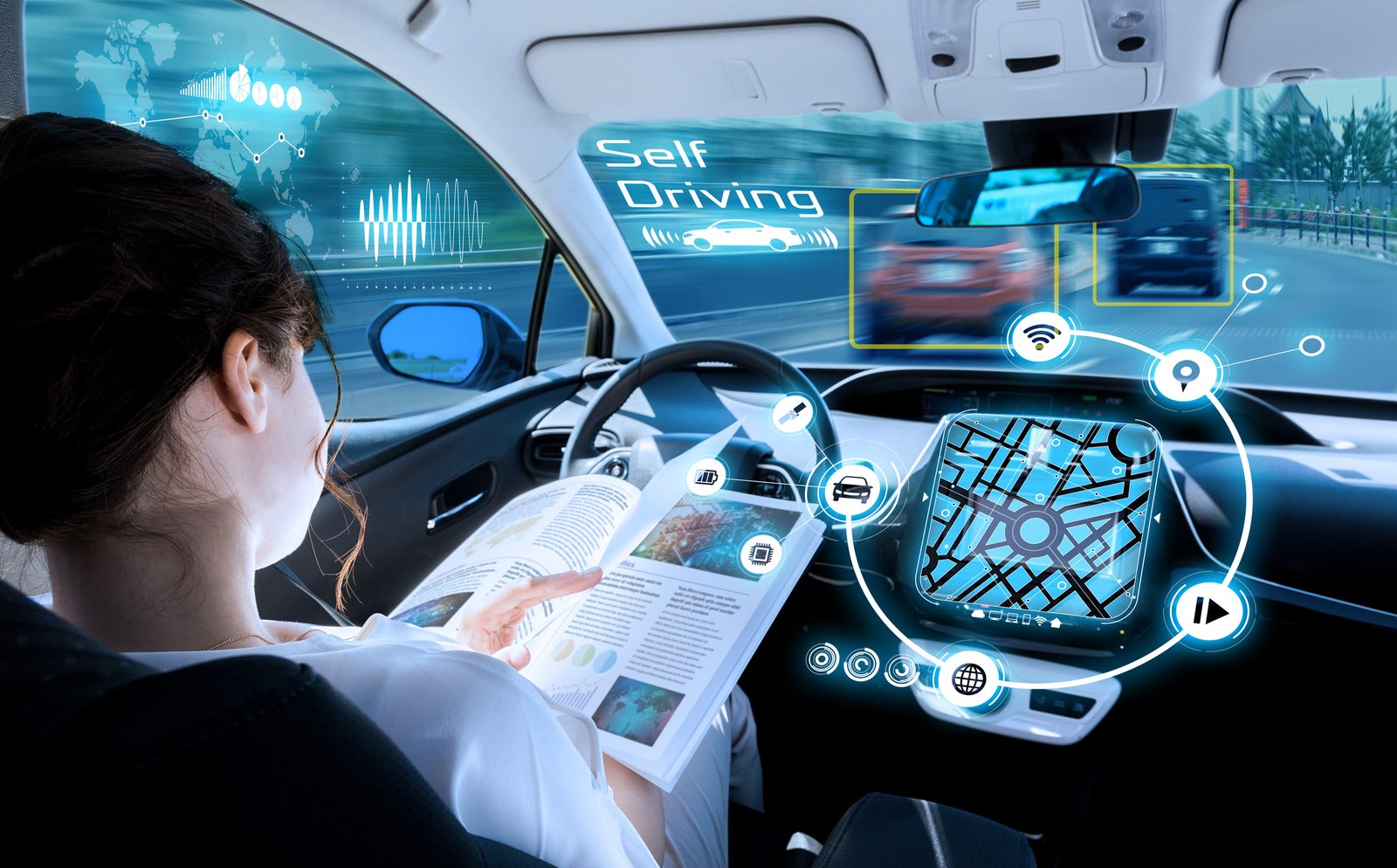
While full self-driving remains a complex challenge, advanced systems like GM’s Super Cruise, Ford’s BlueCruise, and Tesla’s Autopilot offer hands-free driving on mapped highways. They use driver-facing cameras to ensure you’re paying attention, but they handle steering, acceleration, and braking for miles on end. It’s transforming long trips from a task into a supervised activity.
The Car That Knows You
Biometric technology is personalizing the cabin.
- Facial Recognition & Fingerprint Sensors: The car recognizes you as you approach, automatically adjusting your seat, mirrors, climate, and playlist.
- Driver Monitoring Systems (DMS): Cameras track head position and eye gaze. If you show signs of drowsiness or distraction (looking at your phone too long), it alerts you. In more advanced systems, it can even pull the car over safely if it detects a medical emergency.
Conclusion: A Symphony of Silicon and Soul
So, what’s the net effect of all this tech? It’s a bifurcation of the driving experience. On one hand, technology is removing the drudgery. The stressful, repetitive, energy-sapping parts of driving—navigating traffic, parallel parking, long highway slogs—are being automated or heavily assisted. This frees us up.
On the other hand, for those times when we want to drive, technology is amplifying the joy. It makes cars safer to push to their limits, more responsive, and more adaptable to our mood. It connects us to the world and our lives in ways a simple radio never could.
The car is no longer just a means of transport. It’s a connected, intelligent sanctuary. It’s a space that protects us, understands us, entertains us, and carries us forward—not just down the road, but into a new era of mobility. The machine is learning. And in doing so, it’s teaching us new ways to move.
FAQs
1. With all this automation, are we losing the “skill” of driving?
It’s a valid concern. Core skills like spatial awareness and defensive driving remain crucial. However, the nature of the skill is shifting. The future driver may need to be more of a system manager and supervisor, understanding how to interact with and oversee advanced technology, rather than solely focusing on minute-to-minute control. The joy of manual control will likely remain a choice for enthusiasts, much like riding a horse is today.
2. Is all this tech making cars less reliable and more expensive to fix?
It’s a double-edged sword. While complex sensors and screens can be costly to repair out of warranty, the underlying electric powertrains have far fewer moving parts and require less routine maintenance. Also, OTA updates can fix software bugs without a service visit. The long-term reliability story is still being written, but the failure modes are changing from mechanical to digital.
3. I’m not tech-savvy. Will modern cars be too complicated for me?
Manufacturers are intensely aware of this. The best modern systems are designed for intuitive use. Voice commands, simple touch menus, and physical buttons for critical functions (like volume and temperature) are standard. The learning curve is often about letting go of old habits and trusting the assists. Most new owners adapt very quickly and wonder how they ever lived without them.
4. What about data privacy? My car is collecting a lot of information.
This is arguably the most important question of the connected car era. Your vehicle is collecting vast amounts of data on driving habits, location, and even cabin audio. It’s critical to read the privacy policy of your manufacturer. Understand what data is collected, how it’s used (for improving systems, selling to third parties?), and what controls you have. This is a new frontier for consumer rights.
5. Has technology made cars safer, or has it just created new distractions?
The data is overwhelmingly clear: it has made them significantly safer. Features like AEB and Lane Departure Warning directly prevent accidents. However, poor implementation of infotainment systems can be distracting. The industry is addressing this with better voice control, driver monitoring systems, and simplified interfaces. The net effect is a massive positive—technology is catching the mistakes that drivers have always made.